Basement Microphones: The Last Places in America Where Nobody Is Performing
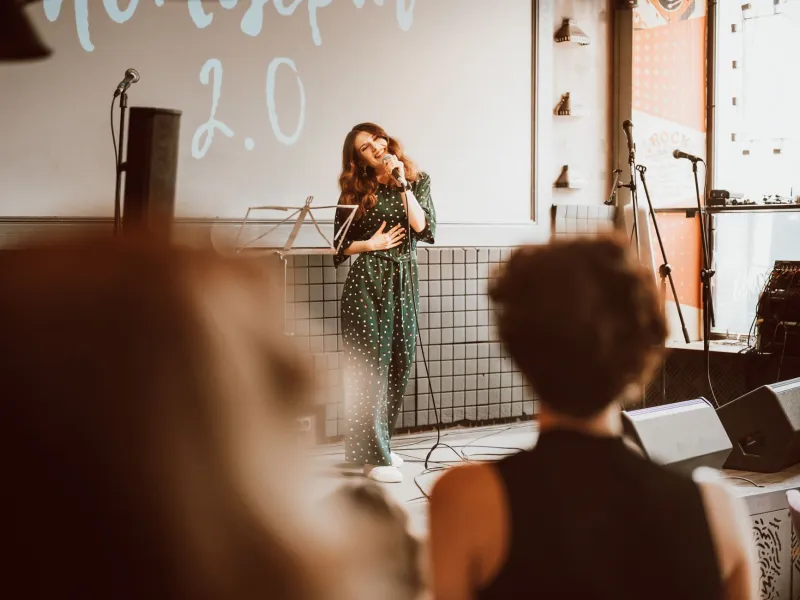
The sign-up sheet at the Gowanus coffee shop is a spiral notebook with a pen tied to it by yarn, and by 7 p.m. there are twenty-three names on it. A woman in scrubs. A teenager with a legal pad. A retired mailman who writes, in careful cursive, "Tom — poem about my brother."
Nobody here is getting paid. Nobody here is going viral. And that is precisely why they're here.
The Economy of the Five Minutes
I spent a month going to open mics — poetry slams in Brooklyn, a comedy cellar under a Chicago pizza joint, a reading night in the back room of a diner in rural Ohio where the waitress reads between shifts. What struck me, night after night, was the same thing: the material. Not the craft — some of it was rough — but the content. These were people telling rooms of strangers things they had never told their spouses, their mothers, their group chats.
A man in Chicago did a five-minute set about his son's overdose, and the room held completely still. Afterward I asked him if his family knew he did this. "They know I go out on Thursdays," he said.
We talk a lot about how curated American life has become — the Instagram face, the LinkedIn voice, the family group chat where everyone performs wellness. But there's a parallel economy running in church basements and bar back rooms. It runs on five-minute slots and a $4 latte minimum. It has no algorithm and no archive. The poem happens and then it's gone.
Ohio, 8 P.M., Between the Meatloaf and the Pie
The diner reading in Marietta was the night that broke me a little. Twelve people around pushed-together tables. A high school English teacher read about her father's dementia. A guy who worked at the plant read something rhyming and funny and then, in the last stanza, not funny at all. The waitress, Rhonda, read a piece about her ex-husband that had the whole room laughing and then completely silent, and she stood there afterward and said, "OK, who wants pie?"
That's the thing about these rooms. They don't ask you to choose between the raw thing and ordinary life. The raw thing comes with pie.
Why Strangers Get the Truth First
There's a reason people confess to rooms of strangers before they confess to their families. A stranger has no leverage. They can't bring it up at Thanksgiving. They can't weaponize it in an argument next June. The open mic is a one-way valve: the truth goes out, and nothing comes back but applause or silence, and both are survivable.
Psychologists call this the stranger-on-a-train effect, but the open mic version is better, because you're not just venting — you're making something. You've put your worst night into a shape. You've given it a last line. That's not just catharsis. That's authorship of your own story.
The Rooms Are Disappearing
Here's the part that worries me. These spaces are fragile. Rent goes up, the coffee shop closes, the basement gets converted into apartments. And unlike a curated feed, an open mic can't be scaled, monetized, or archived. Its whole value is that it exists nowhere else.
So go. Find the night at your local bookshop or brewery or diner. Sign the spiral notebook. Read the poem about your brother. Nobody's filming. Nobody's ranking. For five minutes, you're the least curated person in America, and the room — a room full of people equally uncurated — will hold it for you.
Then Rhonda will ask who wants pie, and you'll say yes, and that will be the most honest transaction of your week.